"What a costume designer does is a cross between magic and camouflage."
- Edith Head
Today's Google Doodle inspired me to write a quick post about the famous Hollywood costume designer, Edith Head.
Today's Google Doodle in honor of Edith Head's 116th birthday.
Head's career in Hollywood spanned over 50 years and includes over 400 film credits as Head Costume Designer, 35 Oscar nominations and 8 Academy Award wins. She is still to this day the most honored costume designer and woman in the history of the Academy.
Ironically Head had very little art and design experience- let alone costume design experience- when she began her Hollywood career back in 1924. She actually was a French teacher with a masters degree in romance languages from Stanford. Her first job was teaching French at the Hollywood School for Girls. Looking to make a little more money, Head also offered to teach art in addition to French despite having only studied the subject briefly in high school.
A young Edith Head, mostly likely taken around the start of her Paramount career. Via.
While taking college art classes at night to polish up her skills for her teaching position, Head discovered a passion and talent for design. In 1924 she applied for a costume sketch artist position at Paramount Pictures using, she admitted in late years, a fellow student's art portfolio. Despite having no professional experience and submitting someone else's portfolio, Head earned the job.
"You can have anything in life, if you dress for it." - Edith Head
She started off designing costumes for silent movie pictures, with her first credit being The Wanderer in 1925. By the 1930's- just a few short years later- she had established herself as one of Hollywood's leading costume designers.
Actress, Natalie Wood's eyes go round with excitement while looking at Head's costume sketches. Via.
She costumed numerous leading ladies and men, with her costumes completing the illusions they portrayed on screen. Head quickly became a favorite among the Hollywood stars, known for dressing actors impeccably, and for a diverse range of characters. Some of her films include: The Lady Eve, Sullivan's Travels, Holiday Inn, Sunset Boulevard, All About Eve, A Place in the Sun, Roman Holiday, Rear Window, To Catch a Thief, The Sting, and many, many more.
Head with Elizabeth Taylor at a costume fitting for A Place in the Sun. Via.
"Your dress should be tight enough to show you're a woman,
and loose enough to show you're a lady."
- Edith Head's words of wisdom
Head worked for Paramount Pictures for 43 years, before moving to Universal Studios, a move many attribute to her frequent partnership with director Alfred Hitchcock, who was at Universal as well. She continued to work in film throughout the rest of her life, taking on smaller projects in her later years such as made-for-TV movies. The last film she worked on was the Steve Martin and Carl Reiner comedy, Dead Men Don't Wear Plaid; it premiered shortly after her death in 1981 and was dedicated in her memory.
Today, October 28th, 2013, Edith Head would have been 116 years old. She will always be remembered for her immense design talent, and for the crucial role she played in making the Golden Era of Hollywood the epic generation of film its known as today.
A picture of Edith Head at work, from a LIFE magazine spread. Via.
Lisa Helene.
Sources: 1 and 2. Visit both for more information on Edith Head's life and career.
To me, Howard Hawks' 1940 film, His Girl Friday is quite a unique movie for its time. This film, which is based on the play The Front Page, delves into the fast-paced world of journalism. As the title screen explains, it depicts the "dark ages of the newspaper game" when "getting that story justified anything short of murder." The journalists in His Girl Friday are the now-cliche "old time-y" newspapermen wearing their fedora hats and talking in a funny accent with a cigarette clench between their teeth. I can't say for certain if in 1940 this was an accurate depiction of journalists, or if it was Hollywood doing what it does best- exaggerated and romanticizing reality for dramatic effect. Either way it is a thoroughly entertaining film that keeps you laughing with its jokes, your head spinning with the crazy-fast dialogue, and, if you watch closely, an interesting representation of a modern and independent woman for the 1940's.
Cary Grant as Walter and Rosalind Russell as Hildy. Via.
At the beginning of the film you are quickly introduced to Hildy (Rosalind Russell), an ex-newspaper gal who's dropping by her old stomping grounds in order to tell her ex-editor, who is more importantly also her ex-husband, that she is getting married and quitting the newspaper racket for good. Of course Walter (Cary Grant) has no intention of letting her go- from the newspaper or from his life.
The ex-husband coming between the soon-to-be newlyweds. Via.
Although very similar to the original play, Front Page, Howard Hawks' made one major adjustment to the screenplay- a change that came about by complete accident. In the original story, the character of Hildy Johnson is a male. During early screenplay readings, Hawks had his secretary read Hildy's lines, which made him realize that the fast witty dialogue sounded even better with a female in the mix.
Rosalind Russell was just the actress to be added to the mix. Via.
Hawks took a witty and fast-talking male character and turned him into one of the most clever and modern parts written for a woman. At the time His Girl Friday was released, Hildy was one of Hollywood's few female movie characters who was equal to her male counterpart. Hildy can give as good as she gets, never letting her ex-husband Walter get the upper hand despite all his tricks and schemes.
Not only can Hildy banter with the best of them, she also is unique in the sense that she's not the typical 1940's housewife. As much as she tries to convince Walter- and, more importantly herself- that she really does want to quit the newspaper biz and settle down as housewife, it's clear that it's not what she really wants. Hildy repeatedly says that she wants to have a "normal" life, but what is normal? I find it fascinating that this 1940's movie features a woman who doesn't end up as the "normal" housewife. Instead it shows an alternative lifestyle that involves chasing down witnesses and hunting down exclusives. One of the main themes of the film is that Hildy, a woman, not only survives in a man's industry, but flourishes in it.
It's also obvious that she doesn't want to be taken care of or treated with kid gloves like the way her new finance (Ralph Bellamy) treats her. She's the one who always trying to take charge in their relationship and tell him what to do; Hildy is definitely the pants-wearer in the relationship. Walter, however, knows that Hildy doesn't need to be taken care of. He knows she can handle anything that's thrown at her- and Walter throws a lot of trouble her way.
The original trailer for His Girl Friday gives you a sneak peek at this hilarious screwball comedy.
Hawks, who was known for featuring strong female characters in all his films, actually insisted that he was not a feminist nor a feminist supporter. Ironically however, he did admit that strong, independent, and ambitious females were the type of women he was attracted to, which explains why he spotlighted them so often.
Grant, Russell, and Hawks onset of His Girl Friday.Via.
No one could have pulled off the character of Hildy with such sass and conviction as Rosalind Russell, but it's actually luck that she won the part at all. Russel was far down on Hawks' list of possible lead actresses. And, unfortunately, Russell knew she was no where near the director's first choice. This led to her being very self-conscious and insecure at first on set. After the first few stressful days of filming, Russell had had enough. In a very Hildy fashion, she marched up to Hawks and said, "You don't want me, do you? Well, you're stuck with me so you might as well make the most of it." From then on, Hawks took her more seriously.
Another challenge for Russell was Hawks' encouragement for the actors to ad-lib and improvise during filming, which Russell wasn't use to or comfortable with. The other lead actor however was more than comfortable with ad-libbing; Cary Grant was known for his improvisation skills and used them to the fullest while filming His Girl Friday. One of my personal favorites is his line "Listen, the last man who said that to me was Archie Leach just a week before he cut his throat." For those of you who might not know, Cary Grant's birth name was Archie Leach. (Fun fact: Grant also slyly referenced his 'real name' in a improvised line for the film Arsenic and Old Lace.)
This clip gives you a glimpse at Grant's hilarious improve skills.
Russell however did not have such skills. So to keep up with Grant's extemporizing, Russell secretly hired someone to write jokes into her scenes for her. Each day Russell would show-up on set with her pre-planned "ad-libs" for the scene they were scheduled to shoot. Although Hawks never caught on to Russell's setup, Grant did. After the first couple days, Grant started to greet her each morning with a smile saying, "Well what have you got today?"
In addition to improvising, Hawks also directed the actor to cut each other off and talk over each other to keep the fast-paced dialogue more realistic. Shortly before he started working on the script for His Girl Friday, Hawks had the realization that in real life people don't wait for others to finish talking before starting themselves, especially when arguing. It's only natural to have conversation that's overlapping. After realizing this, Hawks and his screenwriting team purposely "wrote the dialog in a way that made the beginnings and ends of sentences unnecessary," in order to facilitate fast-paced and natural conversation flow. The dialogue is actually so fast-paced that the substantial 191-paged screenplay translated into a film that is only 92 minutes long. The quick banter also led to a breakthrough in sound recording for film; because His Girl Friday was filmed before multi-track sound recording, they used multiple microphones which had to be continuously turned on and off in time with the flow of the dialogue. Some scenes required the sound mixer to make over 35 switches during a single shot.
This hilarious (albeit blurry scene) is a great example of the fast-paced dialogue of His Girl Friday.
To this day His Girl Friday is a charming and funny film. The jokes still make you laugh and the fast dialogue still keeps you on the edge of your seat. Hawks' film is a classic screwball comedy, and a rare example of a modern 1940's woman who proves she's equal to her male counterpart.
Since its release in 1960, Alfred Hitchcock’s Psycho has shaped, inspired, and
completely permeated pop cultural. It has influenced numerous film makers, and
has become so ingrained in our film and cinematic culture that it’s
recognizable even to people who have yet to even see the movie. Famous scenes
from this film are still used and parodied in movies and TV shows today, over
50 years later. Psycho turned two
shrill notes on a violin into the haunting sound of a killer looming into the scene.
It made a swinging ceiling light bulb the perfect addition to a cinematic standoff
with death. And of course, it made a porcelain white shower the perfect locale
to commit murder. These, and other horror flick trademarks, all affectionately
hark back to Hitchcock’s Psycho, the
film that set the standard for horror thrillers.
In 1959 prolific crime novelist, Robert Bloch published the
novel, Psycho, which was loosely
based on the real-life story of an obscene small-town murderer, Ed Gein. Alfred
Hitchcock’s personal assistant discovered the novel and brought it to
Hitchcock’s attention. After he read the novel himself, Hitchcock anonymously bid
on the rights, acquiring the story for a mere $9,000. Hitchcock’s initial idea
for Psycho was actually inspired by the
series of bad, inexpensively-made “B” horror flicks that were so successfully
at the time. Hitchcock was curious to see what would happen if he made a good,
inexpensively-made horror flick. He shot the entire film using the film crew
from his television show, Hitchcock Presents, and chose to film in black and
white to cut costs. Shooting in black and white would also help tame the gory scenes
in the script, and make it (a little) easier to pass through the censorship.
The novel itself was actually much more gory and gruesome
than Hitchcock’s film. Hitchcock and screenwriter Joseph Stefano worked through
the novel, changing and adapting the story into a script. Stefano was actually in
Freudian analysis himself at the time, and greatly relied on his own
experiences in therapy while working on the script, especially when developing the
dark, yet sympathetic, villain Norman Bates. Stefano also quickly impressed
Hitchcock with the idea to deviate from the novel and start the film with
Marion’s story and point of view rather than Norman Bates’. Hitchcock quickly
latched on to this idea, adding that they should get a big-name star to play
that role, in order to shock the audience even more with the character’s sudden
death.
Shocking the audience was always Hitchcock’s main motive.
Once publicity for the film began, Hitchcock designed the promotional trailers
and posters to feature Janet Leigh (Marion), solidifying in the public’s mind
that Leigh was indeed the star of the picture. That way the audience would be
so taken aback by her abrupt murder less than a quarter ways through the film.
Hitchcock even filmed a scene of co-star Vera Miles screaming in a shower just
for the trailer, making the shower sequence even more unexpected.
Hitchcock's very long and very droll original trailer for Psycho.
See 6:00 mark for Vera Miles shower cameo.
Leigh’s death wasn’t the only secret Hitchcock had to keep.
He also went to great lengths to keep up the idea that there really was a “Mrs.
Bates.” Hitchcock felt that the plot twist involving Norman’s mother was the
true fun and thrill of the story; the audience had to be convinced to the very
end that Mrs. Bates was indeed alive. During pre-production, Hitchcock spread
casting rumors for the part of “Mrs. Bates;” for weeks agents were calling and
sending in their recommendations, vying to get their clients an audition for
the role of “Mother.”
Even after shooting finished, the sly secrecy continued.
Hitchcock refused to have early showings for newspapers and reviewers, making
them see the film with the rest of the public; he feared that early reviews
would spoil the twist ending for the general public. Taking it even one step
further, Hitchcock had posters and cutouts of himself made for all the theaters
that would be showing Psycho. The
signage warned all patrons that “No one… but NO ONE” would be allowed into the
theater after the showing began.
He wanted to make sure everyone saw the film
from the beginning; to Hitchcock’s thinking, if audience members came into the
theater late, they would be sitting there wondering where Janet Leigh was. Hitchcock
also didn’t want anything to distract the viewers from the story being played
out on screen. This led to another concern for Hitchcock- his own role in the
film.
Hitchcock’s signature cameo in all his films actually began out
of necessity back during his silent era. His film budgets back then were much
smaller than the budgets he was granted once he signed with Paramount Pictures.
In order to physically fill up crowd shots, everyone on set- including Hitchcock-
would appear in the scene. Once Hitchcock became more well-known, so did his
face and distinct, rotund figure; audiences began to recognize and pick him out
in his films. This quickly became a game for both Hitchcock and the audience:
when and where would you see Hitchcock in this film? What started out as a
mischievous game however quickly became a complication for Hitchcock. If the
audience was too busy looking for his cameo, then they wouldn't be paying
attention to the story. So with Psycho,
and all of his subsequent films, Hitchcock strategically placed his cameo early
on in the film before any significant storytelling began. This way, he was
still playing this ongoing game of hide-and-seek with the audience, but without
disrupting the mood of the film.
Hitchcock's Psycho cameo. In the first 10 minutes of the film.
Once the scenes were all shot- including Hitchcock’s cameo-
the crew and some of the cast gathered to watch the rough cut. And, according
to screenwriter Stefano, it was horrible. He recalled being so disappointed
after that first viewing, and having no idea how to admit this to his director.
Hitchcock however, just patted Stefano on the leg and reminded him “it’s only a
rough cut.” The film then went on to Bernard Herrmann who performed a miracle;
he wrote and added the now-famous Psycho
theme. His original compositions, made up solely of string instruments,
completed the film. After viewing the film again with the added score, Stefano
described it as being a completely different movie. It made that rough cut into
a cinematic experience.
For its time, the Psycho
had some pretty racy scenes in it. It explicitly discussed and displayed illicit pre-marital sex, nudity, and insanity. Many people were scandalized by the various
scenes of Janet Leigh undressing or laying around in her slip and bra. There
was also a big upset about the use of the word “transvestite” in the
psychiatrist scene. What I find most
entertaining however is the reactions people had to the famous shower scene.
Hitchcock and Leigh rehearsing the shower sequence. Via.
This 3 minute scene required 78 shot set-ups and took 7 full
days to film. It’s a fantastic scene that makes your heart race no matter how
many times you've seen it. What’s most interesting is the illusion of the
sequence. Not once do you ever see the knife actually pierce Leigh’s skin. The
stabbing is instead represented with the rapid cuts in the film; the audience automatically
associates every film “cut” as another literal “cut” with the knife. Audience
members, however, were so convinced by Hitchcock’s cinematic device, that many
left the theater talking about the gory stabbing, describing the knife slashing
through Marion’s skin as if they saw it. One reviewer was so engrossed by the
scene that he actually described Marion’s red blood swirling down the drain- in
the black and white movie. Many audience members however agreed, swearing they
saw the red blood as well.
Hitchcock was such a visionary, making his films not simply
entertainment, but an experience. While all aspects of Psycho are astounding- the story, the characters, the acting- what
really makes this film so prevalent today is the sheer mastery of this film. As
Hitchcock said, when people watch Psycho
they are “aroused by pure film.” Even if you’re not schooled in film technique
or even if you don’t consider yourself a film enthusiast, it’s still impossible
not to notice the how inventive and creative this movie is. All around, it’s an
exceptional example of film at its best.
Lisa Helene.
Just for fun, here are some fan-made, minimalist movie posters for Psycho that I think Hitchcock would have loved:
I love how this one is reminiscent of the opening title sequence. Via.
When exploring the vast catalog of classic films,
continually returning to Bette Davis is inevitable. Her repertoire of films is
incredibly extensive and diverse. That’s why, despite the fact I just featured
her in a recent blog post about Of Human Bondage,
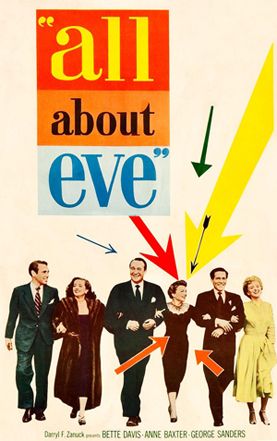
I am once again revisiting Bette Davis. I recently re-watched the 1950 classic,
All About Eve, and was struck (not for the first time) by the geniuses and fearlessness of Davis. She was the Meryl Streep of
her day; or more accurately, Meryl Streep is the Bette Davis of today.
Portrait of Bette Davis: Queen of Melodrama Film. Via
Taking on the turbulent and cut-throat world of professional theater, All About Eve examines both the rise and
fall of stage actors, and the ruthless means they’ll take to attain or maintain
stardom. This film is basically the definition of the phrase “art imitating
life.” While watching the film’s depiction of Broadway, it’s impossible not to
see its resemblance to Hollywood. Despite different coasts and different communication
channels, these two forms of performance art are not that different from one
another.They are both fueled by ambition, betrayal, ego, and greed.
"If nothing else, there's applause... like waves of love pouring over the footlights." - Eve Harrington
Much like her character, Margo Channing, Bette Davis in 1950
found herself being labeled as "an aging film star.” Davis was 42
years old and experiencing a steady decline in her career. After 18 years as
Warner Brother’s reigning leading lady, they opted to not renew her contract in
1949. Everyone- including Davis- figured this was the end of her career.
Meanwhile, writer/director Joseph Mankiewicz had adapted the
Cosmopolitan short story “The Wisdom of Eve” into the screenplay which would
eventually become All About Eve. Darryl
Zanuck of Twentieth Century Fox agreed to produce the film; his first act as
producer was dubbing the film, All About
Eve.
As is with all productions, the next step was to start
casting. Only the supporting cast members, including Celeste Holm and Thelma
Ritter, were original cast picks who actually made it into the film. It is
actually sheer luck that Bette Davis and Anne Baxter got to immortalize the
lead roles of Margo and Eve. Claudette Colbert and Jeanne Crain were originally
cast as Margo and Eve, respectively. Just before production was about to
commence, Crain found out she was pregnant, and Baxter was brought in as a last
minute substitute. Shortly after finding out Crain was pregnant, the studio
received bad news from their other leading lady. Colbert had fallen while
filming a fight scene for a different movie, breaking her back and forcing her
to drop out of the All About Eve production.
Enter Bette Davis.
"Fasten your seat belts, it's going to be a bumpy night."
- Margo Channing
Mankiewicz and Zanuck went through several possible replacements for Colbert, before finally calling Davis, who was then deemed
“box-office poison.” That however was not the only reason Zanuck loathed having to bring in Davis; he also personally detested the actress- and the feeling was mutual. But as
temperamental as Davis could be, she was also shrewd enough to recognize a once in
a lifetime opportunity when it landed in her lap. As soon as she read the script, she knew Margo
was a dream role and could possibly be the salvation of her career.
"Margo is a great star, a true star. She never was or will be anything less or anything else." - Addison DeWitt
After Davis had been cast, the rumors and gossip spread like
wild fire. Mankiewicz received numerous letters and phone calls from directors
who had previously worked with Davis; they warned him that working with Davis
would be a nightmare; that she would be demanding and essentially try to take
over the picture. Davis’ fellow All About
Eve cast members gossiped amongst themselves about what it would be like
“working with the Queen Bee.” Celeste
Holm recalled Gary Merrill (who would be playing Davis’ love interest, Bill, in the film) saying at least “it’ll all be over in eight weeks.” Quickly after
Merrill met Davis, however, that eight weeks turned into ten years and eight
weeks.
Bette Davis and Gary Merrill on the set of All About Eve. Their chemistry, on and off screen, was instantaneous. Via.
As Holm described it, “Bette had taken one look at Gary and
Gary had taken one look at Bette, and something had happened." Despite
early apprehension, Merrill and Davis quickly became inseparable. Just as
filming wrapped up, so did Merrill and Davis’ marriages; a few days later the
two were married in Mexico just hours after Merrill’s divorce was finalized.
Despite the whirlwind start of their romance and marriage, ten years later it came to an end. Davis once confessed to her All About Eve co-star, Anne Baxter, that it took her and Gary ten years to realize that “he married Margo Channing, not Bette Davis. And she married Bill Sampson, not Gary Merrill.”
When filming for All About Eve began, Merrill was not the only one caught off guard by Davis;
director Joseph Mankiewicz was also surprised. After all the warnings he had
received, Davis was a complete professional on set, readily listening to and
accepting direction and advice from Mankiewicz. When Mankiewicz confessed his
early fears and the warnings he had received, Davis herself admitted the gossip
was warranted. She said she could be difficult- but only when she “had no
confidence in the script or the director.” After recognizing early on what an accomplished
scrip All About Eve was, Davis had
nothing but respect for Mankiewicz.
Even years later, Davis still credited him
for saving her career with All About Eve
and the character of Margo Channing. “He handed me the beginning of a new life
professionally and personally,” Davis exalted in her autobiography. Davis also had
nothing but nice things to say about the cast, crew, and production of All About Eve.
"I can think of no project that from the outset was as
rewarding from the first day to the last. It is easy to understand why. It was
a great script, had a great director, and was a cast of professionals all with
parts they liked. It was a charmed production from the word go."- Bette
Davis
Despite the last-minute casting and the forewarning rumors, All About Eve came together seamlessly. All the performances are outstanding. I can't even imagine Claudette Colbert playing Margo, because Davis was such a perfect fit for the role; she effortlessly captured both the diva-esque temperament, and also the self-doubting venerability of Margo Channing. Similarly Anne Baxter wowed in the titular role of Eve. She balanced the sweet and innocent facade of Eve, as well as the manipulative, fame-seeking harpy that lies beneath the surface.
The cast rounds out with supporting performances that are just as impressive, most notably George Sanders in the role of Addison DeWitt, the slimy theater critic who observes- and encourages- the drama that unfolds. There is also an entertaining cameo by the then-newcomer Marilyn Monroe; another example of art imitating life (and vise versa), Monroe plays an ingenue actress who flirts and charms industry decision-makers in hopes of securing her big break.
All About Eve opened
to both critical and public acclaim, and earned 14 nomination- a record that
has yet to be surpassed and was only recently matched by Titanic in 1997. That isn't the only record All About Eve can boast; it was also the first time that two
actresses from the same film were both nominated for Best Actress. When the
1951 nomination season came around, Anne Baxter demanded Twentieth Century put
her name in for the Best Actress category not Supporting Actress- an ambitious move that definitely reflects her character Eve. This put Baxter and Davis in direct competition for the Oscar. Neither won
the race, the award going instead to Judy Holliday for Born Yesterday.
Samples from Anne Baxter's All About Eve wardrobe tests. Via.
Many speculate that the Academy was divided by
Baxter and Davis, and as a result the underdog won. Whether or not that’s true
is still up for debate, however Baxter even said herself in the Oscar aftermath
that she should have stuck with the Best Supporting category. Bette Davis
responded in a very Margo Channing manner saying, “Yes, she should have.”
Art imitating life. Davis, Merrill, and Baxter in All About Eve. Via.
Even though no All
About Eve leading lady went home with a trophy, the film has stood the test
of time (much more so than Holliday’s Born
Yesterday). The film (which was adapted into the Broadway musical Applause in 1970) is still considered
one of the best screenplays and one of greatest ensemble performances to be
captured on screen.
One great script, two gorgeous men, and a lot of good
acting; that, in essence, sums up the classic 1973 con movie, The Sting. In all seriousness though,
there is so much to keep you entertained while watching The Sting -from the acting to the fast paced dialogue to all the plot twists and turns- I’m not quite sure how someone could not like
this movie.
After the box-office success of the 1967 film, Bonnie and Clyde, 1930’s gangster films
experienced a resurgence in Hollywood. While researching the art and
crime of pickpocketing for a previous film, screenwriter David S. Ward became fascinating with old time
confidence men. Through his research, he got the idea for The Sting: an elaborate script with twists and turns, comedy and
action, and one elaborate con job.
The lead character of Johnny Hooker was actually written
with Robert Redford in mind, however the box office star needed a little
convincing before finally agreeing to take on the role. Even after filming
began, Redford never believed the movie would be such a hit, let alone an Academy Award-winning film that would still be revered today.
Ironically, Paul Newman’s part of Henry Gondorff was
originally written as a much smaller, more supporting role. Once Newman showed
interest in joining the film, the part was re-written in order to take
advantage of the great (and lucrative) on-screen chemistry between Newman and
Redford.
This wasn’t the first time the duo had worked together. In
1969 Newman and Redford worked together in another crime film: Butch Cassidy and the Sundance Kid.
After the critical and box office success of Butch Cassidy, the studio was more than excited to pair these two
actors together again. Joining them on The Sting as well, was Butch Cassidy
director George Roy Hill. The comfortable and compatible nature of the trio’s partnership is obvious in
both films.
With just the screenplay and the amazing actors behind the
camera, The Sting was a guaranteed
success (despite Redford’s doubts), but once they added the great sets,
costumes, and music into the mix, The
Sting became a classic.
Being a Chicagoan myself, I love movies that take place in
my city, especially those that depict a historical Chicago. Despite the
majority of the movie being filmed on Hollywood sets, The Sting offers an authentic look at Chicago in the 1930’s. From LaSalle
Street Station to the 43rd Street el stop, you can get a glimpse of the city as it use to be and visualize what it would have been like back
in the day. The color scheme of the film is great too- with muted browns, dark maroons,
and forest greens, it effectively produces the perfect tone for a
depression-struck, but still-tough city that has too much character to give in.
In addition to the authentic sets, you also have the costumes
designed by the great Edith Head. Head actually won her 8th and final
Academy Award for the wardrobe she designed for The Sting. During her acceptance speech, she summed up the honor
explaining, “Just imagine, dressing the two handsomest men in the world and
then getting this." I think we can all agree with Edith’s sentiments.
Costume designer, Edith Head, with Robert Redford. Via.
But even more than the costumes or scenery, what I love most is
the music. The Sting features several
hits of turn-of-the-century composer, Scott Joplin. His ragtime compositions,
including his most recognizable “The Entertainer,” set the scene in The Sting adding the perfect syncopated rhythm.
Ironically, the ragtime tunes are not of the 1930’s time period; ragtime
actually hit its peak during the first decade of the 20th century, meaning
that Joplin’s music would have already faded into obscurity in the real 1930’s.
Despite this historical misrepresentation, the Joplin-inspired score fits the
movie perfectly, and actually created a temporary ragtime revival in the early 1970’s.
To top off The Sting's perfect combination of visual and auditory components, you have the fantastic Saturday Evening Post-inspired inter-title cards that narrate the
progression of the con. These fabulous illustrations and titles are so unique
and one of a kind. They make the audience feel like they’re flipping through a con playbook while
watching the swindle unfold.
All of these features- the script, the actors, the sets, the
costumes, and the music- all piece together to make a classic and timeless
film. The Sting went on to win 7
Oscars, including Best Picture, Best Director, and Best Screenplay. It is also
(surprisingly) the only film for which Robert Redford was nominated for Best
Actor. The Sting also went on to influence
future con movies, including the 2001 revamp of Oceans 11, which in my opinion displays more characteristic of The Sting rather than its original.
I definitely recommend watching The Sting if you haven’t; it’s a clever and entertaining film that will probably fool
you a couple times too.