On January 1st, for those of you who don't know, Netflix added over 60 films to their online streaming list. For a film-lover like myself, it pretty much made the New Year. They've added really fantastic films, some that I love and some that I haven't had the pleasure to explore yet. One newly added film is Billy Wilder's 1960 classic, The Apartment. I was so excited that this title was now available, that it's one of the first films I watched this year. As I re-watched this classic, I realized that it's actually very appropriate to watch in celebration of the New Year. Not only does it take place during the holiday season, it also reminds you that the New Year is a time to take a look at your life, both the positive and the negative, and embrace necessary change.
Going off the movie poster alone, you'd think The Apartment was another rip-roaring, witty comedy from Billy Wilder; full of big of laughs and love. And the film does start actually off that way initially; you are introduced to C.C. Baxter (Jack Lemmon), an average office worker living the average, uneventful bachelor life. He works in a large skyscraper in the heart of New York City, as just one of the many cogs in the corporate machine. He likes his job, even though he is of a little significance to anyone there. That is except to four executive in his company. To these men, Baxter is "buddy boy;" the office schmuck who they've promised quick promotions in exchange for the use of Baxter's bachelor apartment for their extramarital rendezvous.
"I said I had no family; I didn't say I had an empty apartment." - C.C. Baxter
Baxter alone in his office, waiting for his apartment to be vacated. Via.
Before Baxter knows it, these executives are getting more use of his apartment than he is. He spends most of his time staying late at the office or wandering snow-filled parks, waiting for his bosses and their mistresses to vacate his apartment. And, this "little problem" with his apartment isn't Baxter's only problem.
Jack Lemmon as Baxter, surrendering his apartment key once again. Via.
His next door neighbor, the middle-aged Dr. Dreyfuss, assumes Baxter is the one loudly entertaining a new women every night, and takes every opportunity he can to lecture Baxter about the dangerous road he's on.
"Why don't you grow up, Baxter? Be a mensch! You know what that means?
A mensch- a human being." - Dr. Dreyfuss
Things aren't much better at work either; on top of waiting anxiously for that promised promotion, Baxter struggles daily, attempting to woo the building's elevator girl, Fran Kubelic (Shirley MaClaine). While Baxter dreams of having the title of Junior Executive, Fran dreams of having the title of Boss' Wife.
Unbeknownst to Baxter, Fran happens to be one of the mistresses frequenting his apartment with none other than his boss, Mr. Sheldrake (Fred MacMurray). It all plays out like a typical romantic comedy, that is until Baxter comes home on Christmas Eve to find a broken-hearted Fran unconscious on his bed.
After realizing that, despite all his promises, Sheldrake is never going to leave his wife, Fran in a fit of grief tries to commit suicide, overdosing on sleeping pills at the apartment. Suddenly the romantic comedy takes quite a dark and cynical turn. Thanks to the help of Dr. Dreyfuss next door (who of course thinks Fran took the sleeping pills over Baxter), Fran survives the overdose. She spends the next few days with Baxter at the apartment recovering.
Baxter distracting Fran with a game of rummy. Via.
As Fran recuperates, she and Baxter discuss many things; Mr. Sheldrake, love, and heartbreak. Baxter adorably tries to cheer Fran up and distract her from her heartache. Although this darker twist in the film could easily become over-the-top or melodramatic, it's actually portrayed very subtly and realistic. It's this honesty from both the script and the actors, that makes it all the more heart-wrenching.
Baxter: "The mirror... it's broken."
Fran: "Yes, I know. I like it that way. It makes me look the way I feel."
Behind all the comedy and witty dialogue, you realize that Baxter and Fran are both lonely individuals who fill their lives with fruitless ambition; Baxter thinks the big title and private office is what will make him happy, just as Fran thinks that Sheldrake leaving his wife for her will make her happy.
"Some people take, some people get took. And they know they're getting took and there's nothing they can do about it. - Fran
Fran on New Year's Eve, thinking she finally got what she wanted. Via.
Funny thing though; what we want isn't always what's good for us. In those few days at the apartment, Baxter and Fran find comfort in one another and their similar situations. And once they return to normal life, with Baxter back in the boss' pocket and Fran back in the boss' bed, suddenly the status quo doesn't seem enough any more. Their dreams and ambitions have been overshadowed, by their few days of sincere human interaction at the apartment. They both find themselves entering the New Year with a decision to make; will they listen to their head or their heart?
"Ya know, I use to live like Robinson Crusoe. I mean, shipwrecked among 8 million people.
And then one day I saw a footprint in the sand, and there you were." - Baxter
This why I think The Apartment resonates so well at the New Year. Fran and Baxter remind you that the New Year is a blank slate, a new page. It's the opportunity to candidly look at your life and think about what's working and what's not. Like Fran and Baxter, we all get the chance to change the status quo. Moving forward in 2014 let's all remember to make decisions with both our heads and our hearts, and embrace the change that's needed for us to become a happy, healthy mensches- human beings.
Happy New Year!
Lisa Helene.
While working on this blog post, I found this fan-made movie poster below.
(You do have to have seen the movie to get his one though.)
Alternative poster for The Apartment. Designed by Matt Owen.
Also, take a look at this memo I found.
Director, Alfred Hitchcock sent Billy Wilder a commending note after seeing The Apartment:
In my last post about Citizen Kane, I mentioned the Music Box Theatre; I want to take the opportunity now, to tell you more about this gorgeous theater which I truly consider to be one of Chicago's cinematic gems.
The gorgeous Music Box Theatre. Photo taken by yours truly.
The Music Box opened in the summer of 1929 on the North side of the city. It survived the stock market crash, the depression, and the Second World War. In the 70's and early 80's the theater found itself on hard times and was being used to show everything from Spanish to Arabic language films, and even had a brief career as porn house. The theater was restored and reopened in 1983, and, by good fortune and hard work, it retained its original design and architecture; a true blessing considering the theater's beautiful and ornate interior.
In the main auditorium you find yourself sitting beneath a starry, Tuscan night sky. The deep blue ceiling twinkles with its very own stars, and cloud-like shadows float over the celestial 13-foot dome. Meanwhile, down on the ground, you are surrounded by an Italian courtyard of backlit pillars, lavish curtains and drapery, and vined greenery that dances up the walls. As if that wasn't enough, the theater also boasts an authentic organ chamber, orchestra pit, and even its own ghost!
The organ and organist at the Music Box.
I try to visit the theater as much as possible, not just for the beautiful and historic atmosphere, but also for the great films they show. Today the Music Box is known for showing and supporting independent and foreign films, as well as having special showings of cult hits, sing-a-long shows, and, of course, presentations of classic films. For the past 30 years the Music Box has also held its annual Christmas Show. It's a double feature showing of White Christmas and It's a Wonderful Life. This year, for the first time in my 5 (almost 6) years here in the city, I was able to see this holiday double feature!
The Annual Music Box Christmas Show is great family fun, and a must for any Chicagoan during the holiday season. You sit back under the starry night ceiling and escape into these holiday classics. In between showings you sing (or attempt to sing) carols and even get a visit from the big guy in red! The audience itself also adds to the fun, as the regular Christmas Show patrons cheer for the heroes and heroines, hiss at the villains (such as It's A Wonderful Life's Mr. Potter), and jingle their jingle bells along with the songs. It's fun all around and you are guaranteed to leave the theater overflowing with holiday cheer!
"I'm dreaming of a white Christmas, just like the ones I used to know..."
"Vermont should be beautiful this time of year, all that snow."
The first film in the double feature, is White Christmas, the 1954 holiday musical starring Bing Crosby, Danny Kaye, Rosemary Clooney (yes, of the George Clooneys) and Vera-Ellen. The movie follows the smash musical duo, Bob Wallace (Crosby) and Phil Davis (Kaye), a fictional "Rogers and Hammerstein." While their hit Broadway show is closed for the holidays, they find themselves teaming up with a sassy nightclub sister act (Clooney and Ellen) to help save their former army commander's Vermont inn.
"If you ask me what this place really needs is a dynamite act!"
Like most movie-musicals, the story line is nothing special; a pretty conventional boy meets girl, boy and girl fall in love through song and dance, and, in the end, put on a terrific Broadway show. What makes this movie so great are the songs, the dance numbers, and, most importantly, the talent.
"Even guys with two left feet, come out alright if the girl is sweet."
The Abraham Number; One of my favorite dances in the entire film.
Throughout the movie, the remarkable cast keeps you on the edge of your seat! Danny Kaye keeps you laughing as the goofy best friend; Vera-Ellen and her out-of-this-world dancing keeps you jaw-dropped and speechless; meanwhile, Crosby and Clooney's smooth crooning keeps your toes tapping and fingers snapping.
In additional to their talent, the actors bring pure joy and fun to the film. You can tell from their on-screen interactions that they were having so much fun making this movie. In fact, the parody, drag-version of the "Sister Act" number wasn't actually in the script; the director saw Crosby and Kaye goofing around on set with the girls' feathered fans, and found it so hilarious that he insisted they film it and add it to the movie. It's all around a great movie that will make you smile and laugh, and put you in the holiday spirit.
"You see George, you've really had a wonderful life."
The second film in the Music Box's Christmas Show is It's A Wonderful Life. For me, this is the ultimate Christmas movie. No other holiday film captures the essence of Christmas and family as much as Frank Capra's 1946 classic. It's A Wonderful Life is the tale of George Bailey, your average every-man who has lived through his share of both happiness and disappointments. One Christmas, George finds himself at the end of his rope, thinking the only way out of a financial crisis is suicide. In his time of ultimate need, he is visited by his guardian angel, Clarence Oddbody, AS2 (Angel Second Class). Clarence shows George something we have thought about at one time or another: What the world would be like without us.
This is the aspect of the film that I think is so moving and relatable; we all hope to make our own mark on the world, and make a difference- especially around the holidays. Through George, It's A Wonderful Life shows us that we are all making a difference one way or another. Even in the most seemingly-insignificant of ways, we touch the lives of all those around us every day. The film reminds us that we aren't as small as we sometimes feel in this vast world because, to someone somewhere, we are the world.
"Strange, isn't it? Each man's life touches so many other lives. When he isn't around, he leaves an awful hole, doesn't he?"
I cry every time- can't help it!
"A toast to my big brother George: the riches man in town!"
It's A Wonderful Life wouldn't be the same revered classic without its leading man, Jimmy Stewart. Ironically enough, Stewart almost wasn't in the film and had to be convinced by Lionel Barrymore (Mr. Potter* in the film) to take on the role of George Bailey. Stewart had just recently returned from serving over seas in WWII. Like most who served, Stewart was still trying to adjust back to civilian life and move past all he had seen and witnessed. He was also incredibly self-conscious about his acting after returning and honestly didn't think he could pull the role off. Thankfully for all of us who know and love him as George, he finally agreed to join the production.
Stewart and Capra on set of It's a Wonderful Life. Via.
"Remember George, no man is a failure who has friends."
White Christmas and It's a Wonderful Life are probably my two favorite Christmas movies. I love them both for very different reasons, but they both never fail to put me in the holiday spirit. It wouldn't be a true Christmas season without one viewing (at least) of each of these films. And there's no better place to experience these films than on the big screen at Chicago's Music Box Theatre. Their Annual Christmas Show is going to be one of my holiday traditions from now on, and, if you're in the Chicago area, I highly recommend giving it a try as well! If you can't make their Christmas Show this year, be sure to visit the Music Box after the holidays! It's open year-round and always has new films and special showings scheduled!
Merry Christmas and a very Happy New Year to all my Vintage Marquee readers! Thank you for joining me this year as I started this new adventure in blogging. You can be sure there will be many new posts and movie write-ups to come in the new year!
See you in 2014!
lisa helene.
*Update: In a previous version of this post, Lionel Barrymore was mistakenly credited as Uncle Billy in the film.
A few weeks ago, I had the opportunity to see the 1941 classic, Citizen Kane, on the big screen at Chicago's historic cinematic gem, the Music Box. As part of the theater's 30th re-opening anniversary, the Music Box was showing a series of masterpieces and cult classics. I was lucky enough to get tickets for their showing of Citizen Kane, considered by many to be one of- if not the- greatest movie ever made.
Orson Welles' film pieces together recollections and remembrances of one man's life, like pieces of a puzzle. It fittingly begins with a death; and not just any death, but the death of the publishing tycoon, Charles Foster Kane. While the film opens on his deathbed, it spends the remaining 100 or so minutes, examining Kane's life and trying to answer one seemingly simple question: Who is rosebud?
"Rosebud...It will probably turn out to be a very simple thing."
The story behind the scenes of the 1941 film Citizen Kane has become the stuff of Hollywood legend, and would actually make for a pretty entertaining movie itself. From screenwriting credit feuds to the scandalous real-life basis for the character of Kane, controversy has surrounded the film since its release. However, all of these disputes aside, the making of Citizen Kane is a pretty incredible underdog story of a first-time director and his radio/stage acting troupe who came together to make one of best picture ever made.
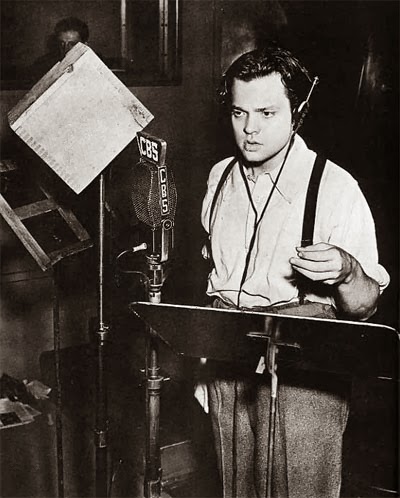
A young Orson Welles during his famous "War of the Worlds" broadcast.. Via.
In 1934, 24 year old Orson Welles was offered the contract of a lifetime from RKO studios. A carte blanche contract allowing Welles to write, direct, produce and act in any movie of his choosing; one film a year and $150,000 per film (plus a percentage of the movies' gross). This was an unheard of agreement in Hollywood at the time. The dollar signs alone made headlines, but what was even more unbelievable was the creative freedom and power being given to a virtually amateur filmmaker. Although Welles had been in stage and radio since he was 16 (founding the Mercury Theatre at the mere age of 21), he had very little knowledge about film which makes this contract deal, and his consequential debut movie, even more astounding.
One of Welles' most famous productions at the Mercury Theatre was his modern-day interpretation of Julius Caesar. Via.
While the RKO studio head who had struck the deal with Welles had confidence in his new talent, other studio decision-makers did not have the same faith. They began to grow worried when Welles kept failing to produce a script for his first movie endeavor. Even after the script for Citizen Kane had been finalized, Welles continued to give the studio heads grey hairs and high blood pressure. Welles took complete advantage of his creative power; he never showed the script fully to the studio heads, only ever giving them bits and pieces of the story line. He refused to follow the traditional Hollywood process of showing the studio the daily film takes after each day of shooting; none of them saw the film 100% until after it was already shot and edited. And if any studio bigwigs decided to surprise Welles with a set visit, Welles had a standing agreement with the entire cast and crew; at the first sight of an RKO employee, they were to drop everything and do anything except work on the film.
"There's only one person in the world who's going to decide what I'm going to do, and that's me."- Charles Foster Kane
Welles wouldn't have been anywhere, however without his co-script writer, Herman Mankiewicz. In 1940, shortly after he signed his contract with RKO, Welles partnered with Mankiewicz to write his first screenplay. Together they conceived the idea of chronicling a man's life in fragmented memories and recollections. This idea was then developed and drafted into a screenplay entitled The American. Switching back and forth from the hands of Mankiewicz and Welles, this script went through 5 different completed versions before finally becoming the Citizen Kane we know and love today. With each script edit, the character of Kane became more developed; and the more developed Kane became, the more he began to resemble a well known public figure of the time.
William Randolph Hearst was the publishing mogul of early 20th century who built the nation's largest newspaper chain and media conglomerate. Mankiewicz, being a personal friend of Hearst's longtime mistress Marion Davies, was a frequent guest of Hearst's personal castle, San Simeon. It is strongly theorized that Mankiewicz, at Welles' request, wrote Hearst's personal stories and scandals into the script. Although most evidence suggests this theory is correct, Welles denied this for many years. Many believe that Welles based Kane off of Hearst simply for a publicity hack; a quick way to shock and get people talking about his debut film. Others believe Welles was criticizing Hearst, his life style, and his fellow business moguls. Whether his purpose was self-promotion or social commentary, it's undeniable that Welles shamelessly used Hearst's life when crafting Charles Foster Kane.
The similarities between Hearst and Kane are so obvious, it's actually laughable that Welles tried to deny it. In the first 5 minutes of the film you learn Kane, like Hearst, is the nation's most successful newspaper publisher. Just as Hearst had San Simeon, Kane had his own lavish castle, Xanadu. During his later life, Hearst had a very public and scandalous affair with actress, Marion Davies; in Citizen Kane we see Kane woo, romance, and, in the end, stifle the shop girl-turned-opera singer, Susan Alexander. The similarities only continue to pile up from there.
The biggest kicker though, and the thing that reportedly drove Hearst over the edge, was Welles' use of the phrase "rosebud." It's the enigmatic word that Kane whispers just before his death, and is the integral mystery of the film. According Hollywood legend, "rosebud" had quite the significance in Hearst's life as well; rumors have it that it was the nickname that Hearst gave a particular part of Davies' anatomy, to put it modestly. The fact that Welles knew about this nickname, let a lone used it in his film, frustrated and enraged Hearst to no end. At the time of the film's release, all Hearst newspapers boycotted Welles' film, refusing to review or advertise it. On top of that, Hearst began to campaign around Hollywood, convincing cinema moguls to not show the film in their theater houses. He tried to sue Welles and get RKO to destroy all the existing prints of the film. I can't help but wonder how Hearst must have reacted when he found out that Welles' informant was none other than his frequent house guest, Herman Mankiewicz.
Welles and Mankiewicz meeting to discussion the Citizen Kane script. Via.
This is where the controversy and debates over the screenwriting credits begin. Because the script was being passed back and forth between Welles and Mankiewicz who were on totally different sides of the country, it has become foggy which man contributed what to the story. As Mankiewicz , was the source for all of the Hearst gossip and scandal, many question if Welles contributed anything to the script at all. According to several of Mankiewicz's friends and family, he alone wrote the script with no help from Welles. Meanwhile Welles and his supporters claim that although Mankiewicz is responsible for the initial shell of the script, Welles is the one who edited and added, making Citizen Kane what it is today. As always, every story had two sides; in the end, the two men split the screenwriting credit, much to Mankiewicz's disgruntlement. Despite the shared credit, the debate continues still today long after both Welles and Mankeiwicz's death.
"It's the greatest curse that's ever been inflicted on the human race: memory."
Even if Welles didn't contributed to the script as he claimed, you still cannot deny that Citizen Kane is Welles' own vision and creation. His directing is so personalize and unique, and although the story line is great, it's really the directing that makes Citizen Kane a masterpiece. His stunning camera movements and angles make the movie an aesthetic experience. Citizen Kane marks one of the first times in American cinema that the camera is actually part of the movie. In most films of the time, and even still today, you have an unobtrusive camera; the camera positioning is kept so seamless that audiences are not even be aware of it. Welles however does the complete opposite in Citizen Kane. Welles' camera is part of the storytelling in a very obvious and purposeful way. Throughout the film, the camera is flying through doors and windows; it travels up through the lofts and catwalks of the opera house; low angle shots, high angle shots. They were all strategically planned by Welles, for a specific cinematic purpose.
This short entrance sequence took hours to film, using craned cameras and set pieces that automatically dismantled.
Another signature of Welles' directing that never fails to leave me speechless, is his use of lighting. As paradoxical as it sounds, Welles' brings so much color to this black and white film. With the contrast of light and shadow, he brings a new dimension and texture to the medium of film. It has such a modern look and feel to it, that as you're watching you find yourself forgetting that this film is over 70 years old.
I just love the lighting in this projection room scene.
"Old age.
It's the only disease, Mr. Thompson,
that you don't look forward to being cured of."
One aspect of Citizen Kane that is always, unfortunately, over-looked is the acting. Citizen Kane boasts severe contrasts of youth and old age which every actor supremely accomplishes. Almost every character is shown both in flashbacks and in the contemporary time the film takes place in. This means every principle actor has to portray a drastic aging in their character. Every time I see this film, I am blown away by how authentic and believable the aging of each character is. It's a true testament to the actors' stage background, that none of them solely rely on the makeup or costumes to "age" themselves; they all adapt their voices, movements, and gestures to portray their character's old age. Character aging in film is a art that can easily cross the dangerous line of over-the-top and hokey. Yet, none of the portrayals in Citizen Kane suffer this flaw; they are all realistic and expertly executed.
Welles arriving at the premiere of Citizen Kane.Via.
"I don't think there's one word that can describe a man's life."
An interesting and incredible sad anecdote from Citizen Kane, is that Welles' ending for the character of Kane was actually self-professing. Although the Hearst-inspired Kane turns into an overweight, unhappy, and lonely old man, the end of Hearst's life was very different. He enjoyed life and his love, Davies, to the very end, dying among his loved ones. It's Welles, not Hearst, who went on to suffer career-breaking failures, a series of unhappy marriages, and extreme obesity. And, just as Kane's publishing empire came tumbling down in the film, so did Welles' Hollywood career which never did fully recover from Hearst's ire over Citizen Kane.
"I guess 'rosebud' is just a piece in a jigsaw puzzle...a missing piece."
Although it was a sad end for Welles, he did successfully leave his mark in cinematic history with Citizen Kane. It's a stunning film that deserves multiple viewings. If you haven't seen it yet, it's a must-see. Most critics and film enthusiasts agree that Citizen Kane is an ingenious, cinematic work of art that revolutionized American film and still inspires filmmakers today.
If you've already seen it, do you think it's "the greatest movie ever made." Citizen Kane was actually just recently dethroned of that title by Alfred Hitchcock's Vertigo. Do you think Hitchcock's film deserved to replace Citizen Kane? Share your thoughts in the comments below!
Fred and Ginger. Bogart and Bacall. Hepburn and Tracy. Those are just a few of the famous on-screen couples of the golden era of Hollywood. Their chemistry kept audiences entertained, intrigued, and begging for more. In old Hollywood, when it became clear that two actors had a great on-screen magic- and more importantly box-office success - studio heads did not hesitate to find more opportunities to pair their two stars and milk the chemistry for all they could. William Powell and Myrna Loy were no exception. Starring in over a dozens films together, 6 of which were part of The Thin Man series, Powell and Loy re-defined modern marriage and provided an idealized marital romance for audiences everywhere.
Great Cover for Dashiell Hammett's novel The Thin Man.Via.
It all started thanks to Dashiell Hammett, the American novelist known for his hard-boiled detective crime novels. In 1934 Hammett introduced the world to Nick and Nora Charles; the sophisticated, high class couple who also solve crimes on the side. Hammett's novel, The Thin Man, quickly became a literary hit, and fell into the hands of MGM director W.S. Van Dyke. As a fan of mystery novels, Van Dyke devoured the book and knew immediately that Nick and Nora's story would make a terrific film. After finding out that MGM had already acquired the story rights, Van Dyke quickly began campaigning to head the film.
William Powell, Myrna Loy, and director, Van Dyke. Via.
Van Dyke's dream finally came to fruition later that year when MGM approved the film adaptation. Van Dyke immediately knew who he wanted to take on the married detective duo: William Powell and Myrna Loy. Van Dyke had just collaborated with the pair earlier that year on the film Manhattan Melodrama. He had been completely charmed and inspired by Powell and Loy's chemistry both on screen and in between takes. He knew they would be able to perfectly portray the Charles' loving, but banter-filled relationship.
MGM however did not agree. Having both got their start in the silent pictures of early Hollywood, Powell and Loy were considered veteran actors by 1934. Loy, who was only 29 years old at the time, was looked at as old and washed-up. Typical Hollywood. The studio heads also couldn't picture either actor as glamorous socialites. Powell had been typecast throughout the silent era as the perfect villain, and transitioned to the other side of the law in a series of B-movie detective talkies. Loy's career had been crippled by typecasting as well, known for portraying vamps and Oriental seductresses (leave it to Old Hollywood to be ever so racist). The Thin Man was the perfect opportunity for Powell and Loy to breakout of these typecasts and try their hand at new characters. Thanks to Van Dyke, who wasn't afraid to pull his weight with the studio heads, Powell and Loy finally got that chance.
Casting wasn't the only thing Van Dyke immediately decided on. He also directed screenwriters, Albert Hackett and Frances Goodrick (a married duo themselves), to play up Nick and Nora's quirky relationship and their witty banter in the script. This move made the story's crimey case a secondary subplot, focusing instead on the couple and their modern marriage.
"You know, that sounds like an interesting case. Why don't you take it?" - Nora
"I don't have the time. I'm too busy seeing you don't lose any of the money I married you for." - Nick
Prior to the release of the first Thin Man movie, marriage had two primary roles in film plots. It was the end-goal of light romances and comedies, where the couple finally ends up together and the picture closes with a shot of them walking down the aisle. Or marriage was the catalyst for conflict in tense melodramas, where the married couple wrestles with infidelity, financial issues, or marital discontentment. The Thin Man however introduced a new type of marriage.
"Let us eat, drink, and be merry, for tomorrow we die."
"You give such charming parties, Mr. Charles."
"Thank you, Mrs. Charles."
Nick and Nora hosting an extravagant Christmas party. Via.
Nick and Nora Charles are rich, glamorous, and very much in love despite being in an established marriage. Instead of dealing with infidelity or unhappiness, they enjoy one another's company and have fun together. They are also childless (at least for the first few films), which means their only charge is their dog, Asta. With no responsibilities besides their pooch, and no financial worries thanks to Nora's considerable inheritance, the Charles' have quite the idyllic situation.
Introducing Nick and Nora Charles.
"Do you want a drink." - Nora
"What do you think?"- Nick
The Charles' instead spend their time gallivanting around town enjoying drinks (oh so many drinks!) in the chicest nightclubs, and taking on the occasional detective case for fun. Enjoying dual residency between NYC and San Francisco, they are cross-country travelers who enjoy the finest in life along the way. Nick and Nora made marriage fun- something audiences at the time we're not used to seeing in film. They teased and bickered, but they also worked together and genuinely loved each other.
Also, despite their lofty status, the Charles' still had colorful friends from not-so-glamorous backgrounds, thanks to Nick's past career as a private eye. Crooks, criminals, and mob members all visit the Charles', some lending a hand in their latest case and others asking the couple for their help. For the depression era, I think this was a key factor to Nick and Nora's likability; sure they are living the worry-free good life, but they're also down-to-earth at the same time, instead of being stuck-up and snobby.
"We want to go someplace and get the taste of
respectability out of our mouths." - Nick
Powell and Loy continued to entertain through 5 Thin Man sequels, not to mention 8 other non-Thin Man films. They made 14 successful movies together, and although their on-screen chemistry never permeated their off-screen relationship, Powell and Loy still portrayed the perfect, happily married couple.
An example of Nick and Nora's quirky and playful relationship. Via.
Audiences, in fact, were so convinced by their on-screen romance, that many believed Powell and Loy were married in real life. When the pair first arrived in San Francisco to begin filming the first Thin Man sequel, the management at the hotel where the entire cast was staying excitedly handed over a key to their finest penthouse suite, for "Mr. and Mrs. Powell." The situation was awkward not just because they weren't actually married, but also because Powell's finance at the time, Jean Harlow, had accompanied him on the trip. Thankfully Harlow found the situation hilarious and announced that she and Loy would share the suite together. Powell was moved to the only other available room- a much less extravagant single room several floors down.
Loy, Powell, and Jean Harlow arriving in San Francisco. Unfortunately one of the last pictures of Harlow before her unexpected death. Via.
Nick and Nora's relationship wasn't just fun for audiences, it was also fun for Powell and Loy. It was so easy for them to portray Nick and Nora because, despite being just friends, they had a unique companionship. Throughout the filming of all the Thin Man series, Powell and Loy both experienced misfortunes in their personal lives. Shortly after the second Thin Man film, Powell's finance Jean Harlow died very unexpectedly and tragically. Not long after, Powell was diagnosed with cancer and had to undergo extensive medical treatment. Loy went through a series of husbands and very public divorces throughout her Thin Man days, which started to become a professional issue considering her "perfect wife" film personae. Together they comforted one another, and saw each other through dark times by teasing, bickering and goofing around- just like Nick and Nora.
Powell and Loy goofing around together on set. Via.
This ease and comfort between the two of them transitioned seamlessly onscreen. As Powell said, "We weren't acting. We were just two people in perfect harmony." Similarly, Loy said "I never enjoyed my work more than when I worked with William Powell." Together they revived their careers, broke out of their respective type casts, and made a life-long friendship. They also introduced the world to a new type of movie marriage based on love, humor, and adventure- and kept the audiences laughing the entire time!